Saturday, March 14, 2015

Review of Red Nails by Robert E. Howard


Red Nails is a tale of Conan the Barbarian that was first published in Weird Tales in 1936.  This version of the story is in the public domain, and is available from Project Gutenberg.  
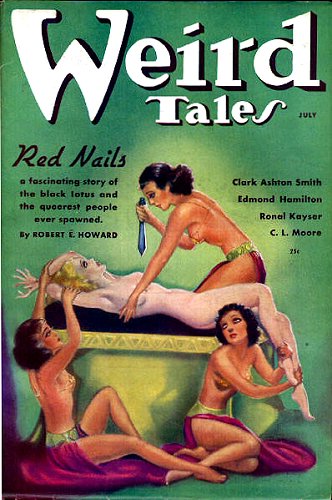
Weird Tales July 1936.jpg
Cover to Weird Tales July 1936
Art by Margaret Brundage

I have read some Conan stories many years ago in my youth, and my memories of them were quite fond.  I recently downloaded a bunch of Robert E. Howard stories that are in the public domain and I decided to read a Conan story for old times sake.  Red Nails follows Conan and his companion Valeria as they stumble upon a mysterious city in the desert.  Conan and Valeria become involved in a feud between the crazed inhabitants of the city.  There is action, magic, lust, and enough bloodshed to satisfy the pulp fan.

The Conan of Howard’s tales is a more likable fellow that the taciturn and gloomy caricature made famous in the Schwarzenegger films.  In Red Nails he gloats so much about his deeds that Valeria quips, “"Is there anything you haven't been?"  Howard writes him as a larger than life superhero, leaping off the page at the reader in a burst of adventure.

My favorite character in this story was Valeria, Conan’s pirate companion.  While Conan can work his way through problems with his brawn and cunning, Valeria actually has to overcome trouble throughout the tale.  She is quite competent, a great fighter and dastardly rogue who serves as Conan’s equal as well as object of rescue.  This is what I liked about her.  While Conan can defeat anything in his way, Valeria occasionally has bad luck and must persevere or get help.  If only there was a tale of Valeria’s exploits to read!

Red Nails has many of the Swords and Sorcery tropes that fans will be looking for.  Sinister magic, monsters, and tribes of degenerate men with bloodlust in their eyes.  The modern reader will need to bear with Howard’s archaic attitudes towards race and gender.   To his credit Valeria is written as a strong woman, but she eventually ends up trembling in Conan’s arms nonetheless.  As long as you can remember that this is pulp adventure and not deep social commentary then the story can be enjoyed at face value.

I would recommend this to fans of fantasy and pulp action who want some escapism for a Saturday afternoon.  If you want to read a book where limbs are cut off and you don’t have to take anything too seriously, then read this story.  It is not perfect, but it is a nice capsule of the pulp genre.

Red Nails as Gaming Material

The plot of Red Nails is perfect for being adapted for an rpg adventure.  The basic story involves the player characters stumbling into an ancient city in a desolate region.  The city has traps, treasure, secret doors, crazy warring inhabitants, and its own internal lighting system.  This is a dungeon crawl written before dungeon crawls.  I highly suggest that any GM who needs inspiration for an adventure should read this story.

The cool part is that the idea can translate well to other genres.  If you are running a sci-fi game, then turn the city into a lost generation ship or abandoned colony.  If it is a cyberpunk game, then make the city some forgotten corporate mini-state.  If you you are running urban fantasy or horror, then this is the monster city that exists in the catacombs of New York.  The story is only 67 pages and has plenty of action to move it along.  I recommend it to GMs, particularly those who are interested in the literary influences on the original D&D authors.

Sunday, March 8, 2015

Book Review - Wolf in White Van


Review of Wolf in White Van by John Darnielle, with a Digression on Play-by-Mail Games


Wolf in White Van is the story of a teenager/young man who grew up in a life of enui and escapism.  He suffers a disfiguring “accident” and lives his life running a complex play-by-mail role-playing game.  John Darnielle, the author, has been called “the greatest lyricist of his generation”.  I have never heard one of his songs but after reading his debut novel I believe it.  

Darnielle’s prose has an infectious quality that creeps into your skull.  There were many points during my reading where I felt that I was sitting among the characters and watching the story.  It helped that I shared many traits with the protagonist, such as a love of Conan and fantasy and a willingness to use that fantasy to escape the doldrums of suburban existence.  Reading this book made me feel like I was becoming delusional from inhaling the smoke coming of the burning ruins of my childhood.    

The main character runs a play-by-mail game called Trace Italian. This allows him to earn money while staying at home, since his accident has left his face horribly damaged.  He invented the game while recovering in the hospital. Players in the game try to navigate a post-apocalyptic landscape in order to reach the safety of the Trace Italian, a mythical fort built by survivors.  Players are constantly making choices on their quest to security, which is forever out of reach.  The whole novel is a meditation on the choices we make and the blame we try to place when tragedy hits, as well as fantasy and reality and their intersection in our minds.

This is a thoughtful, sad, and emotional book that is worth the read.  If you considered yourself a freak or outsider during high school, or wanted to know what that felt like, then this book will give you an emotional tour of what it was like.  I give it five out of five Robert E. Howard fanzines.

Appendix A - Play-by-Mail Games, What are Those?

Play-by-mail gaming has been around since the early days of hobby gaming.  The board game Diplomacy has a long history of being played by the mail, and many early Diplomacy zines were dedicated to postal games.  The game that is shown in Wolf in White Van is of the type where a player sends in their turn, and the game moderator then processes the turn and sends back a response.  Companies usually charge per turn.  

I remember seeing ads for these types of games in various magazines during the 80's and 90's.  There was even a magazine dedicated to play-by-mail gaming called Paper Mayhem, which was published in Ottawa,Illinois, a town I lived in for a while as a youth.  It would seem that video games and the internet would choke off the need for the play-by-mail format, but there are still some companies operating games.  The biggest change is that turns are usually sent by email, but the idea is the same.  Various players send in their turns, and the moderator processes these turns (usually with a computer program) and sends back the results.


Flying Buffalo published Tunnels and Trolls, one of my favorite rpgs.  They also run various play-by-mail games.  I played one of them called World Wide Battle Plan.  It is a global war game where you control a country.  You build armies, send out spies, launch missiles and engage in diplomacy.  It was complex and interesting.

Flying Buffalo runs many games, including one based on their popular Nuclear War card game.  They have science fiction games, wargames, fantasy games, and more.


I used to see the ad for Reality Simulations in Dragon Magazine.  I never played one of their games but I did check out their website.  They run three games; a gladiator game, a wargame based in the Hyborian (i.e. Conan) realm, and an rpg/exploration game set in the Forgotten Realms AD&D setting.  If you are interested in either of those licensed settings they are worth checking out.


The only thing I know about this company is that they won an Origins Award and that they offer games set in Middle Earth.  Again, if this a licensed setting that interests you then check them out.

What do you get out of a play-by-mail game? Back in the 80's, play-by-mail was a way for hobby gamers to find and play games with other hobby gamers.  If you were the only guy in town with an interest in D&D and/or Squad Leader, play-by-mail was a great outlet for playing the games that you wanted to play.  In today's world of the internet, MMORPGs, and Target stores selling Ticket to Ride, does play-by-mail still offer a viable entertainment?

What play-by-mail games offer today is a certain level of sophistication.  These games usually offer the player a multitude of options during play.  Do you raise armies or train spies?  Do you invade the neighboring kingdom or do you build up your navy?  Many of these games gave huge turn sheets that require steel acumen to fill out.  When I played World Wide Battle Plan I felt like a NORAD commander planning tactical strikes from my bunker.  The effort put in gives a sense of accomplishment, and the interaction with dozens of players gives the games a Byzantine feel.  If you want to be a true commander of imaginary men, try one out.

Saturday, March 7, 2015

Favorite RPG Cover Art for RPGCoverArtAppreciationDay


This is my favorite rpg cover art.  I wanted to be this dude.  What the hell is behind those doors?  It looks kinda scary, but I sure want to find out.  If I could find a robe like that I would dress up as the AD&D Dungeon Master for Halloween.  This picture captured what D&D was for me as a kid, something awesome and terrible that lurked behind the doors of imagination.  This book will always have a special place on my shelf.


Wednesday, March 4, 2015

Happy GM Day!

Happy Game Master Day to all of the hard working Dungeon Masters, Referees, Keepers, Storytellers, Game Masters, and everyone else who toils away behind the screen so that we can keep playing our rpgs.  If you have never GMed, give it a try.  It will give you a new appreciation for your game.  If you are the GM, hats off to you.

By the way, rpgnow is having a GM Day sale.  Game on!

Saturday, February 28, 2015

Anna Dressed in Blood: A Book Review

Anna Dressed in Blood - A book review and part of the 2015 Witches & Witchcraft Reading Challenge!


Summary


Anna Dressed in Blood is a young adult urban fantasy book by Kendare Blake.  The story follows Cas, a teenage ghost killer who roams the country with his witch mother dispatching murderous spirits.  Cas uses his father’s athame, a mystical blade that can cut and kill ghosts.  He and his mother (his father was killed by a ghost) move from town to town knocking of vengeful spirits who are murdering the living. Cas and his mom move to Thunder Bay, a small city where the ghost of a teenage kill named Anna Dressed in Blood has been committing murders. Cas will find out that there is something different about this spirit while he continues to research clues about his father's killer.


What I Thought


I enjoyed how the story played with the relationship between Cas and the spirit he is sent to kill.  The tale turns into an examination of the kill-the-monster-of-the-week trope" and asks questions such as, “What if that monster that you are killing actually has feelings?”  There is also some refreshing reflection as Cas ponders his fate as a ghost killer.  What kind of future does a teenage monster killer have?  The world of the book was cool. It felt like the world where I grew up, only at a perpendicular angle.  I had the sense that these spirits could exist in some version of my high school experience. The characters where compelling and I look forward to reading the second book in this series.


Witchcraft Elements


Cas is not a witch, but his mother is.  Also, witchcraft plays an important role in the story as many of Cas’ friends and helpers use witchcraft to help him in his ghost hunting.  His mother makes a living selling occult supplies. The scenes where she uses her herbs and ointments to protect her son remind me of a loving parent wiping a smudge of ice cream off of their child’s mouth, slightly embarrassing but loving and necessary. Witchcraft and Wicca and prevalent throughout the book and portrayed positively,


Gaming Material

Cas and his mom live the life of murder hobos.  They travel from town to town and kill monsters.  The only thing that they do not do is take their stuff.  This book is ripe with inspiration for any urban fantasy or monster killing campaign.  Any GM who has had player characters wish for magical weapons should take a good look at Cas’ athame and the role that it plays in the story.  Also, the interplay that occurs between Cas and the ghost that he is hunting is prime material for any role playing session.  Any GM who would like to have their players actually interact with the XP machines that the players always attack will gain some great inspiration.  I think that this plot could be lifted and used in any rpg campaign where the characters hunt monsters, from hack and slash fantasy to modern paranormal hunters.  When my copy of Monster of the Week comes in to my FLGS, I will be lifting this plot and running it!

Wednesday, February 25, 2015

Review of Bulletproof Blues - A Superhero RPG

Disclaimer - I was provided with a complimentary copy of the PDF of this game by designers.  This review is based on a reading of the rules.

Bulletproof Blues is a superhero rpg that I would describe as “not rules heavy.”  The product is available as a 268 page PDF and as a print-on-demand softcover from drivethrurpg.com.  The game's designers wanted to emulate modern comics (2000’s), however the rules are utilitarian enough to cover any comics genre.  The tone of the game serves Bronze Age stories and up the best, but again these rules could cover most any comics period.

First Impressions

The rules are laid out in single columns with easy to read text.  Blue boxes containing rules highlights and designer notes are sprinkled throughout the book.  The art is evocative of the comic book world that the game wants you to play in.  The illustrations in the book are superhero scenes that are reminiscent of Golden Age comics, and if I am not mistaken are taken from old comics now in the public domain.  The cover and illustrations of the stated-out heroes and villains are by artist Sean Izaakse have a modern comic look to them.  I would buy a comic drawn by Sean Izaakse!

The Book

Bulletproof Blues is divided into sections.  The introduction gives a brief introduction of the game’s setting.  The designers have created a world based on the Kalos Comics universe.  There are no Kalos Comics, this is just the setting the designers have used to ground their game.  The Kalos universe is a Marvel/DC mash up of common comic book tropes.  The authors also describe their design philosophy behind the game in this section.  An introduction to the mechanics of the system is included, along with a glossary of game terms.  My favorite part from the introduction is the authors’ emphasis on fun first and using the rules as a last resort.

The next section describes character creation.  Superheroes have attributes and powers that are bought using a point-buy system.  There is also an emphasis on creating the identify of your character, their motivations, and fleshing them out as a three dimensional person.

Next attributes, skills, and advantages are presented.   Advantages are sort of like low-level superpowers that normal people would have.  The idea seems to be that if Indiana Jones showed up in your game, he would have advantages rather than superpowers.

Powers come up in the next sections.  Powers are presented individually, rather than being built using effects.  For example, a character can have flying.  Powers can have modifiers to them, such as having an increased range.  Most of the standard superhero powers seem to be here such as super strength, teleportation, etc.

The next section covers equipment.  Weapons, vehicles, and gadgets are covered.  There are no prices or encumbrance rules, which I really like.  Characters are expected to have equipment that matches their powers/hero template.  Of course Buck Rogers has a raygun!

The next section is called Actions, and covers the rules of the game.   My favorite rule is “Don’t use the rules unless you need to.”  The game seems to borrow from 3.x d20 systems, but uses two six-sided dice for resolution.  Characters roll 2d6 and add any modifiers and try to hit a target number. Modifiers are +1,+3, or +6. If you are familiar with standard rpg d20 combat then this system should be easy to understand.

Next, we get the GM Section.  This section has a description if the Kalos Comics universe, the setting that was designed specifically for the game.  The Kalos setting feels like a Marvel/DC/Image modern comics setting.  GMs can do three things with it.  One, run it as is.  It contains all of the tropes for a modern supers setting.  Two, tweak it to fit their favorite modern setting.  As it does contain various comic tropes, such as a Space Station used by a supers team for a base, it can easily be converted to another setting.  Three, use their own setting.

I like the fact that the game has a setting built in.  As a GM I appreciate anything that saves me time and the Kalos setting is ripe for either using or tweaking right out of the book.  The GM section also has advice on storytelling, including a technique called Kishotenketsu.  Kishotenketsu is used in Asian narratives and allows characters motivations and backstories to weave into the game.  I will have to reread this section a few times to understand it, but it is a novel approach and I find its inclusion refreshing.

Next we get the Characters chapter.  There is list of 20 pre-generated characters covering your standard comic archetypes, such as the magic wielding hero, the martial artist, the hero with weather-control, etc.

The book finishes off with a list of Kickstarter backers, credits, CC and OGL licences, and an index.  Yes, the rules are under a Creative Commons license and the Open Game License.   You can check out the system reference document here..

Things I Liked about this Game

The writers of this game are fans of comics and their nerdom bleeds onto the page.  They use examples from real world comics in the text, such as using Red Tornado and the Human Torch as examples of the Elemental archetype.  The Kalos Universe has Leifeld radiation, which shrinks your hands and feet and swells your chest and thighs!  Reading this game felt like reading a superhero comic book rpg rather than an rpg designed for playing superheroes.

Also, the “Use the rules only when necessary” attitude was welcome.  The game has adequate rules for covering most situations, included drowning, vacuum, etc.  But the designers repeatedly tell you to just play the game rather than spend time looking up rules.  Some may find this hand-waving to be too free-form, but I agree with this philosophy of game play and was glad that it was explicitly stated in the rules.  I also like that this game comes as a complete package.  The book gives you all the rules necessary to play, a built in setting, and pre-generated characters to get you started.  The only thing missing is an adventure.

Things that Could be Improved

Either this game is your cup of tea or it isn't.  The designers wrote the game because they were dissatisfied with the superhero rpgs on the market, and wanted to make one that fit their tastes. Bulletproof Blues is a rules-medium game that feels like a modern superhero comic, one where heroes wear colorful spandex but have personal issues and world-threatening nemeses.  If you want a toolkit for creating any power or more complex rules, a published licensed setting, or a hippy narrative story game, then this game isn’t it.  But if you want to emulate comic book stories, then this game can do it for you.

For $15 for the PDF or $30 for the print and PDF combo, you get a complete game full of comic book action.  I give it four out of five cosmic cubes.

Thursday, January 29, 2015

Kickstarter Shoutout: Nefertiti Overdrive

I'm boosting the signal on another rpg Kickstarter.  This one is called Nefertiti Overdrive and it is a high action game that takes place in Ancient Egypt.  I would call it Cleopatra: Warrior Princess the RPG,  I'll go ahead and list 4 reasons why I am excited about this project and why I think you should check it out.


1.  I think that the theme is awesome.  Ancient Egypt is a great place to have adventures and it is a setting that has always captured my imagination.

2.  The art by Kieron O'Gorman looks great.  It is evocative of the setting and screams action.  I would buy this project if it was a comic.

3.  The rules seem an interesting mix of the Cortex system and the Wushu system.  Players are rewarded for being as descriptive as possible with their actions.

4.  The game is inexpensive.  Seven Canadian dollars will get you a pdf while 20 Canadian dollars will get you the print version as well.

Ronald Fraser, the author, has a few other completed Kickstarters under his belt.  The project has already funded so right now they are looking for stretch goals.  I'm hoping that they reach the goal for the Fate Accelerated adaptation.  Check it out and when the game comes out we can run a session via Google Hangouts!